
This morning, August 19, 2010 I was preparing to take my exercise walk when I heard some of our bluebirds emitting alarm cries. Bluebirds emit two major kinds of alarm vocalizations. One is a whistle type vocalization which means a bird eating Accipiter hawk or merlin is nearby. The other is a rapid clucking vocalization which indicates a terrestrial predator such as a snake or cat is visible or a nest competitor such as a woodpecker or starling is threatening the bluebird’s nest site.
The alarm cry was the clucking variety and it was coming from Bob’s martin colony. I walked over and discovered a huge black rack snake caught in a net trap on Bob’s T-14 pole which also has a bluebird box attached. The bluebird box was no longer occupied though bluebirds did raise two broods this year in it. There are also four Troyer Horizontal gourds attached to the bottom of the T-14. Bob’s last martin family fledged from one of the gourds the last week in July and the female martin brought her young back to roost for nearly three weeks. The last time I saw them roosting was the evening of August 14 which is the latest I have ever seen martins roosting in our colonies.
Rat snakes have a sensory organ in the roof of their mouths called the Jacobsen’s organ. Rat snakes “sniff” the air with their tongues, pick up the scent of prey, and then transfer the prey molecules to the Jacobsen’s organ. This organ allows the snake to find its prey by scent as it follows the “trail”. Snakes can find prey in burrows, under rocks/logs, in thick vegetation and in trees or cavities off the ground.
It is possible that a martin fledgling may have slipped in to roost last evening August 18 and I didn’t see it. The rat snake may have picked up the scent. There also could have been some “lingering” scent of martins/bluebirds in the housing. Or the snake may have been crawling through the yard and initiated an exploratory climb up the pole and through the netting.
This was a huge black rat snake and was probably over five feet in length and thick in girth. The ¾ inch square netting caught about six inches of the snake and he/she was completely ensnared. The snake was able to slide through a few until he/she could go no further and then the snake could not back out as the netting had tightened around the snake’s body and caught the body scales.
We don’t kill rat snakes as they do catch some rats even though I have never seen them do so! The only prey I have seen rat snake eat or try to eat has been birds!
I removed the snake and he/she deposited a nasty odor on my hands! Rat snakes are muscular and can wrap around their prey with powerful coils. I gently cut the snake out of the netting and released the snake away from our colonies.
I have used net traps for many years at my previous martin colony in north Florida and now in northwest Louisiana. I caught a lot of gray and red rat snakes in Florida but only one black rat snake back in 2006 at my current colony. Bob caught some snakes when he first moved out here, but has only caught two (including this one) since I have been here. Rat snakes seem to be declining in numbers around our immediate area.
Net traps will catch many rat snakes including huge ones that weave through the netting. Thin rat snakes can sometimes glide through ¾ inch diameter mesh but the smaller ½ inch mesh may catch them; a double layer net trap with both mesh sizes will catch thin and thick snakes. The netting needs to be fluffed out and not matted or flattened against the pole. If the netting is matted or flat, a snake may go over it rather than through the mesh. There should be no gaps between the netting and pole to allow a snake to crawl under the trap as he/she goes up the pole. The net trap needs to present numerous open mesh squares so that the snake will weave through the mesh as if he/she was going through vegetation.
Steve
Here are some photos of this huge rat snake trapped in the netting:
This photo shows the rat snake pulled out from the netting and hanging to the ground.
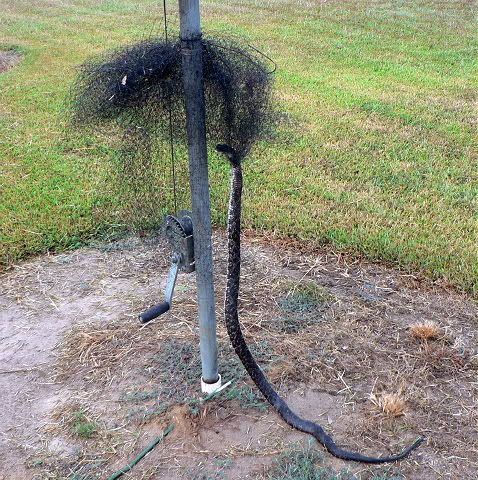
This photo shows the rat snake partially wrapped around the pole/winch with his/her head and neck area trapped in the netting.

This photo shows a close-up of the head/neck of the rat snake ensnared in the netting. You can see how the snake’s body weaved through the mesh and was completely caught. The snake only got about six inches of his/her body into the netting and that was plenty to insure a catch. The snake was hopelessly ensnared and could have never gotten free.

