
Huge Black Rat Snake Caught In Net Trap

Welcome to the internet's gathering place for Purple Martin enthusiasts
Post Reply
Steve Kroenke
Posts: 4342
Joined: Fri Nov 28, 2003 6:49 pm
Location: Louisiana/Logansport

Huge Black Rat Snake Caught In Net Trap

This morning, August 19, 2010 I was preparing to take my exercise walk when I heard some of our bluebirds emitting alarm cries. Bluebirds emit two major kinds of alarm vocalizations. One is a whistle type vocalization which means a bird eating Accipiter hawk or merlin is nearby. The other is a rapid clucking vocalization which indicates a terrestrial predator such as a snake or cat is visible or a nest competitor such as a woodpecker or starling is threatening the bluebird’s nest site.

The alarm cry was the clucking variety and it was coming from Bob’s martin colony. I walked over and discovered a huge black rack snake caught in a net trap on Bob’s T-14 pole which also has a bluebird box attached. The bluebird box was no longer occupied though bluebirds did raise two broods this year in it. There are also four Troyer Horizontal gourds attached to the bottom of the T-14. Bob’s last martin family fledged from one of the gourds the last week in July and the female martin brought her young back to roost for nearly three weeks. The last time I saw them roosting was the evening of August 14 which is the latest I have ever seen martins roosting in our colonies.

Rat snakes have a sensory organ in the roof of their mouths called the Jacobsen’s organ. Rat snakes “sniff” the air with their tongues, pick up the scent of prey, and then transfer the prey molecules to the Jacobsen’s organ. This organ allows the snake to find its prey by scent as it follows the “trail”. Snakes can find prey in burrows, under rocks/logs, in thick vegetation and in trees or cavities off the ground.

It is possible that a martin fledgling may have slipped in to roost last evening August 18 and I didn’t see it. The rat snake may have picked up the scent. There also could have been some “lingering” scent of martins/bluebirds in the housing. Or the snake may have been crawling through the yard and initiated an exploratory climb up the pole and through the netting.

This was a huge black rat snake and was probably over five feet in length and thick in girth. The ¾ inch square netting caught about six inches of the snake and he/she was completely ensnared. The snake was able to slide through a few until he/she could go no further and then the snake could not back out as the netting had tightened around the snake’s body and caught the body scales.

We don’t kill rat snakes as they do catch some rats even though I have never seen them do so! The only prey I have seen rat snake eat or try to eat has been birds!

I removed the snake and he/she deposited a nasty odor on my hands! Rat snakes are muscular and can wrap around their prey with powerful coils. I gently cut the snake out of the netting and released the snake away from our colonies.

I have used net traps for many years at my previous martin colony in north Florida and now in northwest Louisiana. I caught a lot of gray and red rat snakes in Florida but only one black rat snake back in 2006 at my current colony. Bob caught some snakes when he first moved out here, but has only caught two (including this one) since I have been here. Rat snakes seem to be declining in numbers around our immediate area.

Net traps will catch many rat snakes including huge ones that weave through the netting. Thin rat snakes can sometimes glide through ¾ inch diameter mesh but the smaller ½ inch mesh may catch them; a double layer net trap with both mesh sizes will catch thin and thick snakes. The netting needs to be fluffed out and not matted or flattened against the pole. If the netting is matted or flat, a snake may go over it rather than through the mesh. There should be no gaps between the netting and pole to allow a snake to crawl under the trap as he/she goes up the pole. The net trap needs to present numerous open mesh squares so that the snake will weave through the mesh as if he/she was going through vegetation.

Steve

Here are some photos of this huge rat snake trapped in the netting:

This photo shows the rat snake pulled out from the netting and hanging to the ground.
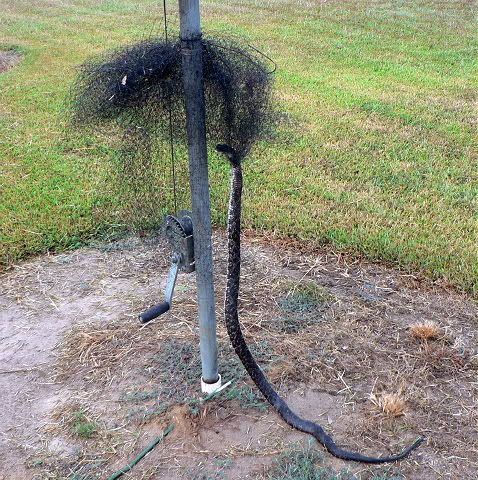
Image

This photo shows the rat snake partially wrapped around the pole/winch with his/her head and neck area trapped in the netting.

Image

This photo shows a close-up of the head/neck of the rat snake ensnared in the netting. You can see how the snake’s body weaved through the mesh and was completely caught. The snake only got about six inches of his/her body into the netting and that was plenty to insure a catch. The snake was hopelessly ensnared and could have never gotten free.

Image
Keith
Posts: 435
Joined: Mon Mar 16, 2009 2:45 pm
Location: Missouri/Ava
Martin Colony History: 85 pair in 2020. Seems fairly consistent the last few years.

Steve,
The netting actually works as can be seen here and the netting stopped a black snake at my site this summer also. I always plan to use the netting in the future. This was the first year I used netting so we could have had problems in previous years and not realized it. Thanks for showing those pictures and perhaps they will teach us a lesson.
Keith
James Strickland FL
Posts: 2249
Joined: Thu Nov 13, 2003 8:04 pm
Location: Reidsville NC
Martin Colony History: 2017 Had a lot visitors no Matins nesting, hoping 2018 will be different.
2018 Had 1 pair
2019 had 30 pair

Steve Great pic and some great info. Pic are truly worth a thousand words.
Guest

Steve,

Great shots. Glad your netting worked. The netting worked for me twice this year. Both houses were full of hatchlings. We definitely have to stay on top of it. My martins are all gone but I have Blue Birds on every twig. Lots of fledgers here. 8)
Guest

Those are some amazing pictures. Thanks for sharing them!
Virgil McCoy
Posts: 302
Joined: Wed Aug 04, 2010 3:06 pm
Location: Louisiana/Alexandria
Martin Colony History: Purple Martin Landlord since 2006

Steve, I wish I had an animal guard or the net as you have in these pictures. My first attempt as a Martin landlord was in Leesville, LA with an aluminum octagon house. Attracted two pairs who nested, hatched, and one morning found a rat snake (just as in your photos) dining on my nestlings one morning. I was to late to save them but learned a valuable lesson. This is the first I've heard of using net material, thanks for the imput.

Virgil McCoy
Proud to be a fourth generation Purple Martin landlord.
Steve Kroenke
Posts: 4342
Joined: Fri Nov 28, 2003 6:49 pm
Location: Louisiana/Logansport

I am glad the photos of the net trap and trapped rat snake have been helpful. I would encourage everyone to have some kind of snake guard on their martin housing poles. Bird netting, like I use, is inexpensive and relatively easy to attach to martin housing poles.

Rat snakes are significant predators of purple martins, particularly martins in the Deep South. However, rat snakes are found in nearly all areas where martins nest.

I have seen rat snakes way out in the country and in well "groomed" suburban yards, so these predators are everywhere.

And they can climb metal and wooden poles with ease. Many folks mistakenly believe that rat snakes can't climb metal poles. The underbellies of rat snakes seem like they have a biological adhesive that allows the snakes to "stick" to almost any substrate. I have seen them climb straight up brick walls, cedar siding, big and small tree trunks, and metal poles of all kinds.

So if you haven't installed some kind of snake guard on your housing, I would encourage you to do so before the next martin season.

Steve
Sam Harris
Posts: 280
Joined: Thu Mar 05, 2009 9:23 am
Location: Oklahoma/Choctaw & Tinker AFB

What size is the netting, and where can I buy it?
Sam
Choctaw, OK


2010...1 pair/5 eggs/5 fledged
2011...2pair/9 eggs/7 fledged
2012...5 pair/28 eggs/25 fledged
2013...12 pair/62 eggs/51 fledged
2014...15 pair/85 eggs/55 fledged
Steve Kroenke
Posts: 4342
Joined: Fri Nov 28, 2003 6:49 pm
Location: Louisiana/Logansport

Hey Sam,

We mainly use 3/4 inch square bird netting and you can usually buy it at most garden centers, home improvement stores like Lowes or Home Depot, Wal-Mart and farm supply businesses like Tractor Supply. You can buy it off the Internet, too but it may be more expensive when you factor in shipping costs. The netting comes in sheets. Bird netting is often used to keep birds from eating berries/fruit.

Ideally, it is probably best to have a combination of 1/2 inch and 3/4 inch square mesh netting and I have done that before. Have a 3/4 inch mesh trap first and then a 1/2 inch layer next. The 1/2 inch netting may catch small thin rat snakes that could possibly weave through the larger 3/4 inch mesh. However, I have had a hard time finding the 1/2 inch stuff. The 3/4 inch mesh has caught most of the rat snakes that have tried to weave through my traps. I have seen some square mesh that was around 5/8 inches and that would work well, too. So mesh size between 1/2 and 3/4 inch is probably a good range for most rat snakes. You don't want it much larger than 3/4 inch because snakes may weave through without getting caught. Rat snakes can squeeze through small places.

Steve
Virgil McCoy
Posts: 302
Joined: Wed Aug 04, 2010 3:06 pm
Location: Louisiana/Alexandria
Martin Colony History: Purple Martin Landlord since 2006

Steve,
You're absolutely right about rat snakes climbing large metal poles. Case in point, I work for a power company and have had rat snakes climb galvanized steel supports much larger in diameter than an animal guard we use on our personal Martin poles.

Virgil McCoy
Proud to be a fourth generation Purple Martin landlord.
Scott D.- La
Posts: 823
Joined: Thu Jun 08, 2006 8:35 am
Location: Louisiana

Hey Steve,
As you know, I have never caught a Rat Snake in my netting...... that is, till now. I was mowing grass yesterday and noticed a 3 foot Rat Snake in the netting. The snake had been there atleast a week and something had ate part of him. He is decaying and smelled fairly bad. The rack is lowered so my only guess would be..... a residual smell of the Martin's interested him in going up the pole. What cha think Steve?
Steve Kroenke
Posts: 4342
Joined: Fri Nov 28, 2003 6:49 pm
Location: Louisiana/Logansport

Hey Scott,

I had never seen rat snakes caught in net traps AFTER the martins have apparently left a colony until this season. And now you had one in a net trap!

There could be several reasons why a rat snake "decided" to climb a martin house pole and then get caught after all the martins were gone. First, there could be some "lingering" scent of martins in your colony. I don't know long such scent would stay around and then trigger a climb by a hungry rat snake. Second, a rat snake may simply have been crawling nearby during the night or early morning and reached the bottom of martin house pole. Then he/she may have decided to climb up like a snake may do at the base of a tree. This could have been an exploratory hunt or climb. Third, the snake may have been frightened by a nearby predator and then tried to climb the pole to get away and got caught in the netting. Since something ate part of the snake in the netting, a predator may be the reason. Skunks and raccoons and even cats may eat snakes and perhaps one of these predators confronted the snake and he/she tried to escape up the pole. But it didn't save the snake!

We once found a skeleton of a rat snake entangled inside a net trap at one of our satellite martin colonies. Unfortunately we didn't find the snake in time to get him/her out but the trap did prevent the snake from climbing the pole.

Thanks for sharing your experience with catching a rat snake in a net trap AFTER all the martins have gone! At least you know your traps are working!

Steve
JJ Jones
Posts: 120
Joined: Thu Nov 20, 2003 11:08 am
Location: Shelbyville, Indiana
Martin Colony History: Average (100) pairs per season

Steve,

Great Pictures! Anyway, where did you purchase the netting at? Thanks!

JJ Jones
Steve Kroenke
Posts: 4342
Joined: Fri Nov 28, 2003 6:49 pm
Location: Louisiana/Logansport

Hey JJ Jones,

I bought my bird netting from Wal-mart. It came in a plastic package with one large folded sheet of netting. It was inexpensive and there was enough netting to make several net traps. I have also purchased the netting from Lowes or Home Depot.

Steve
Sarah Jane
Posts: 6
Joined: Sat Mar 10, 2018 10:46 am
Location: Weatherford, Texas

For those of you with net trap experience, have you ever caught anything else int he netting? I caught a horned toad once. His head got eaten off by the dogs before I noticed him there. In this case, I was just trying to keep the dogs out of a corner of the yard that had gotten muddy, so it covered more than just the base of a pole. I felt bad about it and removed the netting put straw down for the mud.
I have a bat house up in the back wooded are behind the house. I mounted it on a tree per instructions but I am now wondering if it's a good idea to put netting around the base of the tree...I suppose I will experiment with it and see what happens. But I was wondering if anyone had issues with catching other creatures in the netting.
My predators (I have laid eyes on them) are: possum, fox, bob cat, one feral cat, hawks, and owls. Lots of barred owls.
3 Acres on the Brazos River.
2017 - 3 Martin Nests begun after 3/31 in an old plastic PM house, no decoys, no dawn song. No babies.
2018- Feb. Mounted 6 Troyer horizontal gourds w/SREH in exact same spot + decoy. No PMs yet.
Weatherford, TX
flyin-lowe
Posts: 3789
Joined: Wed Mar 29, 2006 8:49 am
Location: Indiana/Henry Co.

You might read up on the bat house forum. I could be wrong but my understanding is bat houses should not be mounted on a tree unless it is some type that has no branches low. Most species of bats require direct sunlight on the houses most if not all of the day. If you have a healthy tree with branches and leaves I don't think it will attract bats. I have tried to attract bats to several different houses for years with no luck.....,
2026 HOSP 27
2025 62 pair HOSP 20
2024 60 pair, HOSP 44
2023 60+ pair, HOSP 8
2022 60 nests with 262 eggs, HOSP 14
2021 62 pair, HOSP 9
2020 42 nest, HOSP 8
2019- 31 pair
2018- 15 pair 49 fledged
2017 3 SY pair, 12 eggs , fledged 10. 4 additional lone SY's
2016 1 pair fledged 4
2015 Visitors
2014 Visitors
2013 Moved 6 miles, 1 pair fledged 2.
2012 30 pair fledged 100.
2011 12 pair 43 fledged.
2010 5 pair 14 fledged.
Post Reply