
A great spring for bird watchers

Welcome to the internet's gathering place for Purple Martin enthusiasts
Post Reply
Scully
Posts: 2009
Joined: Mon Jan 26, 2004 5:35 pm
Location: Texas/San Antonio

The repeated late cold fronts that have given our martins trouble also repeatedly stalled out untold millions of spring migrants returning to our northern forests.

The numbers involved are indeed staggering, I believe estimates running in the one billion range. Suffice to say, northbound songbird migration peaks in April and the first half of May. All through that time a veritable carpet of small birds are pouring across Texas and the South.

My own usual window to this world is a small, nondescript local park wooded with mesquite and hackberry. The appeal being that it is local, and most of the trees are under 30ft in height, bringing the birds closer to eye-level.

Bear in mind, there is nothing special about this park to mark it as a "migrant trap", it is just a snapshot, per acre, of the incredible densities of migrating songbirds moving through, one that I can wander freely, with binoculars, as opposed to the surrounding residential neighborhoods, who's trees and gardens teem with similar numbers, though mostly unnoticed by the human residents.

I was most struck by this over the previous month when I had occasion to drive to Galveston one weekend, and Port Aransas the next, two hundred fifty miles east and one hundred fifty miles south of San Antonio respectively.

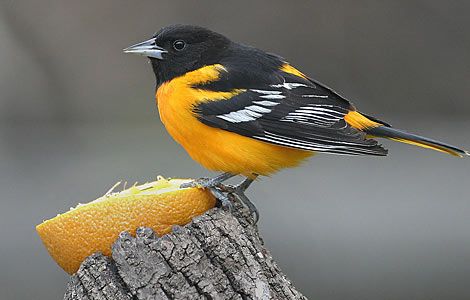
EVERYWHERE I pulled over on these trips, coming and going, I was quickly able to find migrating birds in the trees and bushes. Using Baltimore and Orchard Orioles as an example...... (all photos from internet)....
Image


Image

On migration, these move in noisy flocks through the treetops and thus are easily found, if present. Flocks quickly located in random stops around Galveston, Houston, and points east all the way to San Antonio, moving flocks quickly located every morning in that local park.

The following weekend literally HUNDREDS of orioles in one patch of woodland 100 miles South of San Antonio, large flocks moving along the coast, and large flocks also in the San Antonio area.

As abruptly as they came, the oriole migration has abruptly died down now but what kind of incredible numbers to put so many moving through so many locations over such large areas for weeks on end?

This morning, unseasonably cool and pleasant. Pleasant for humans, not so much for migrants toiling into prevailing north winds. They pile up from the south into these things like interstate traffic into a construction zone, resulting the following morning in trees teeming with furtive and fluttering little shapes, all refueling on insects as fast as they possibly can.

This morning at the park, again just a random snapshot of the carpet of songbirds piling through.....

Blackburnian Warbler, a favorite, and not often seen here, methodically creeping through the foliage....

Image

Hordes of Yellow Warblers moving through the mesquite, these late birds likely going to streamside thickets in the Far North...

Image

American Redstarts, adult males, females and first year males (which resemble females), the beautiful butterflies of the warbler world....

Image


Image

more to post, I'll finish later......
DakotaLady
Posts: 654
Joined: Thu Aug 07, 2008 2:06 pm
Location: Bismarck, ND

I love when the warblers and other various songbirds start migrating up this far north. How wonderful that you take the time in your travels to stop and view the migrating birds. You are so right in saying that most residents do not even notice the migrating back yard birds.
~Tangula~

2013 - 16 pair, 79 eggs, 71 fledged
2012 - 4 pair, 18 eggs, 18 fledged
Don Troha
Posts: 367
Joined: Fri Jul 08, 2011 2:14 pm
Location: Texas/Houston

When the cold front hit here on May 3 my yard was full of migrating songbirds that I've never spotted here before. Hummers, Orioles, and Grosbeaks have been hanging around for over a week. Five or six hummingbirds chasing around, never seen this many together in spring.
2025 - 15 pair, 56 fledged
AvianStewardess
Posts: 342
Joined: Wed May 09, 2012 3:10 pm
Location: Maryland/Cambridge

I've really enjoyed these "articles" on the forum. Thank you for putting them together and sharing.
~Michelle
PMCA Member
Heritage Farm Quad Pod Systems
Scully
Posts: 2009
Joined: Mon Jan 26, 2004 5:35 pm
Location: Texas/San Antonio

Interesting thing is, even more birds come back through going south from August through October, at least twice as many (includng the young of the year), but they are not nearly as obvious. Longer migration period, many dull young of the year, perhaps more concealing vegetation.

Only one that is obvious (other than shorebirds out on local mudflats) are hordes of yellow warblers, this a reflection of the enormous numbers of these things over their huge range, and the fact that they are so attracted to streamside habitats, especially after our dry, hot summers.

Once we did have a front stall out for several days in early October, and the number of "fallouts" was just astonishing. Even more astonishing was the realization that many so migrants pass unseen over our heads each night.

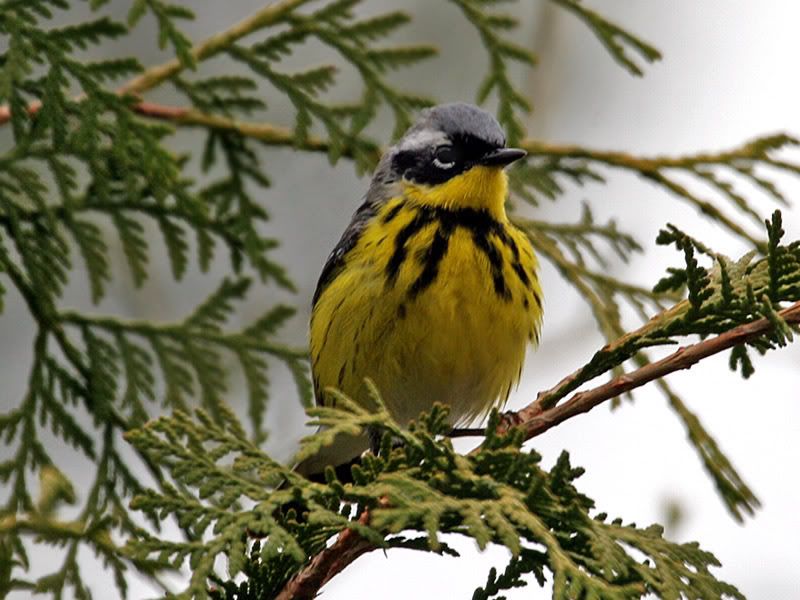
Anyways, moving on, the Magnolia Warbler, ubiquitous in spruce woods up north, is common through here in spring, and certainly among our prettiest warblers....

Image

Less, common, and always a pleasant surprise to find one, the Chestnut -sided Warbler. Regenerating forests, field edges, I always associate them with Vermont, where it seems I see them all over in summer when I'm up there. They do breed across Central Canada too. Out here on the western edge of the flyway as we are I usually figure most of our migrants are these Canadian birds.

Image

The ones that have the really big ranges are ther ones native to the Canadian North Woods; still relatively untouched by humans, because there are so many large numbers of them come through. Here's one: the little Wilson's Warbler, usually seen actively fluttering after insects in dense brush...

Image

More later....
richnet12
Posts: 54
Joined: Wed May 19, 2010 2:12 pm
Location: Texas/Beaumont

I thought migration would be over in Texas by now but this is great.
Excellent photos! Thanks for posting them.
ChrisM
Posts: 143
Joined: Thu Mar 18, 2010 1:01 pm
Location: Hiawatha, Kansas

Beautiful photos..Thank you for posting!
ChrisM
NEKansas
Scully
Posts: 2009
Joined: Mon Jan 26, 2004 5:35 pm
Location: Texas/San Antonio

I thought migration would be over in Texas by now but this is great.
Rich, over by Houston you get even more migrants than we do. If you haven't been already, put High Island on your to-do list, about sixty miles from Houston, on the coast, thirty miles easy of Galveston (we usually take the ferry). Go there in late April and you can do a whole year's worth of birding in a single morning, with multiple differnt kinds of migrants just feet away.

Anyhoo... migration even down here carries on well into May, up at least until the last week in May. Every species is a law unto itself and some don't even come through in numbers until mid-May.

One of these being the Mourning Warbler, a favorite of mine, a ground-dwelling denizen of thick, moist undergrowth....

Image

The volume of sound songbirds can generate is amazing. One spring I had an unseen mourning warbler sing from thick vegetation less than ten feet away, the sound was so intense I could feel it in my sinuses. Clearly these birds project a cone of directed sound waves.

http://www.youtube.com/watch?v=O46OkOx7 ... afe=active

I saw one of the more southerly breeding Kentucky Warblers this past weekend, also a denizen of moist undergrowth, but that was five days ago, and pretty much they are all gone here for the year. Migration comes and goes that quick....

Image

This morning and yesterday morning at another location across the city there were the aforementioned Yellow Warblers all over the place, including singing males. I figure these are the northern population, which, since it is believed bird populations "leapfrog" on migration, likely went the furthest South, clear to Venezuela. If so the ones I saw about an hour ago still have more than 2,000 miles to go :shock:

Mike Scully
Post Reply