

Woulda posted earlier but I've been swamped.
Last year (2011) was our worst martin season ever. We calculated an average of 0.97 fledglings fledging per actual BROOD (let alone "nesting attempt") and that estimate was probably optimistic. An unmitigated disaster for breeding martins in this area; breeding success in 2011 was essentially non-existent, zero.
I have a student crunching some numbers and this year, there is reason for hope.
First off, we have ten solid years of nest check data now on hand, and have estimates of average fledging success per nest for each year.
We looked at the rainfall for August thru February prior to each breeding season to see which correlated most closely with the number of fledglings.
Strangely enough, the best fits were October rainfall and December rainfall (November wasn't a particularly good fit). Adding October rainfall to December rainfall gave an even better fit.
Here's the data, 2002 thru 2011, the average number of fledglings for each year (x10 to show better on the scale) and the total inches of rainfall during the previous October and December of each year....

The next step was to check these numbers for correlation, here it is....
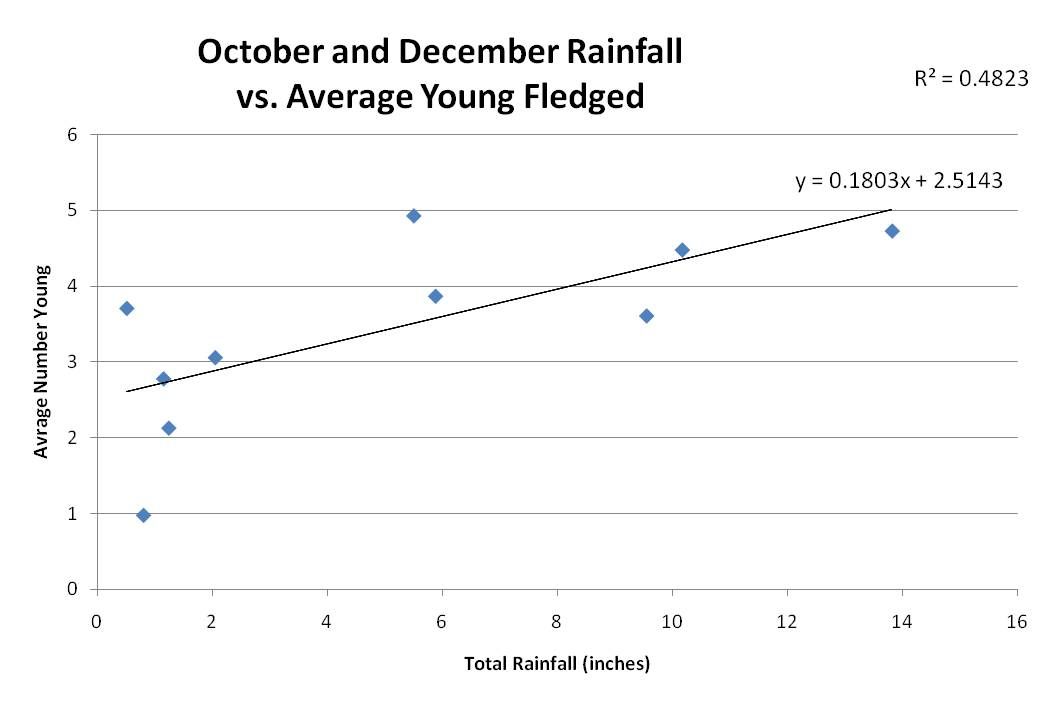
The points don't fit a straight line all that well, but a correlation value ("r square') of 0.48 ain't all that bad a fit for a natural system.
That line equation; Y = 0.1803X + 2.513 can then be used to predict the number of fledglings that will fledge the following season once you have Oct. and Dec. rainfall.
In that equation you put in the rainfall for "X" and the predicted number of nestlings will be "Y".
Here's a table for the last ten years showing how well these predicted results compare to what actually happened...

On a graph, these numbers look like this....

Sooo.... it ain't perfect, but it IS a reason to hope this year wont be entirely a disaster. Our equation predicts better than three fledglings per nest, I fervently hope we see that, or better.
Currently the student is still working up data (like estimating martin success in this area over the last 100 years, and looking for correlations with rainfall upwind from our area) and will compete this spring in science fair.
Ordinarily I might not put out this data just yet, but we all need a reason to hope around here after last year.
Regards,
Mike Scully

 but the concepts do remain solid.