
Steve, thanks for sharing the info on the rat snakes. My martin house is at the end of my boat dock. We have a lot of water moc's in the water here. Have you had any experiece with this type snake; is it also a predator of martin's like the rat snake?
Also, I did not see any mention of electice fencing in your article as a predator guard for snakes. I have been cosidering installing the electric fencing around my pole. Will this not work for snakes?
Tim
Rat Snake Predation On Purple Martin Colonies
-
Tim Mangan-Kansas
- Posts: 1728
- Joined: Wed Mar 15, 2006 7:25 am
- Location: Kansas, Pittsburg
- Martin Colony History: 2016 - 22 Pair
-
Steve Kroenke
- Posts: 4342
- Joined: Fri Nov 28, 2003 6:49 pm
- Location: Louisiana/Logansport
Hey Tim,
Rat snakes will raid martin colonies near water, too!
Water moccasins are not constrictors and kill by "lethal injection". They will eat a variety of prey species, including birds. They eat a lot of aquatic verterbrates like fish and frogs. I have not heard of water moccasins coiling around martin housing poles and climbing them, but that does not mean it can't happen.
You probably have many water snakes, too, and these are harmless to humans. However, they will raid bird nests located along lakesides in bushes or near the ground. Again, I have not heard of water snakes coiling around a martin house pole and then constricting upward. These snakes are not constrictors like rat snakes.
Some folks use the electric fencing method with good success and it will stop rat snakes and other serpents. This method delivers an electric shock to any creature that comes in contact with the fencing. Of course this can kill if the voltage is high enough and I would prefer not to outright kill the snakes or other animals if possible. One other problem with the electric fencing is the loss of power. If you have a power outage due to a storm of some kind of malfunction, then your martin housing is unprotected unless you have a generator.
I prefer to use the net trap method or a combination of PVC/cylinder guards with netting. These methods have worked well for me in the past.
Good luck.
Steve
Rat snakes will raid martin colonies near water, too!
Water moccasins are not constrictors and kill by "lethal injection". They will eat a variety of prey species, including birds. They eat a lot of aquatic verterbrates like fish and frogs. I have not heard of water moccasins coiling around martin housing poles and climbing them, but that does not mean it can't happen.
You probably have many water snakes, too, and these are harmless to humans. However, they will raid bird nests located along lakesides in bushes or near the ground. Again, I have not heard of water snakes coiling around a martin house pole and then constricting upward. These snakes are not constrictors like rat snakes.
Some folks use the electric fencing method with good success and it will stop rat snakes and other serpents. This method delivers an electric shock to any creature that comes in contact with the fencing. Of course this can kill if the voltage is high enough and I would prefer not to outright kill the snakes or other animals if possible. One other problem with the electric fencing is the loss of power. If you have a power outage due to a storm of some kind of malfunction, then your martin housing is unprotected unless you have a generator.
I prefer to use the net trap method or a combination of PVC/cylinder guards with netting. These methods have worked well for me in the past.
Good luck.
Steve
-
Steve Kroenke
- Posts: 4342
- Joined: Fri Nov 28, 2003 6:49 pm
- Location: Louisiana/Logansport
Hey Locoforpurple,
The netting at the bottom of the pole works well and catches the snakes before they can get to the pole.
Yes, the netting works in most cases, but even some real small rat snakes may be able to weave through both 1/2 and 3/4 inch netting. Your case shows that. I have caught small rat snakes that were about 2 feet in length with 1/2 inch netting mesh. Using a combination of netting and PVC is probably the best method to thwart most rat snakes.
Thank you for sharing that information about the real small rat snake. We need to know about the failures of various snake guards and then devise ways to improve them.
Steve
The netting at the bottom of the pole works well and catches the snakes before they can get to the pole.
Yes, the netting works in most cases, but even some real small rat snakes may be able to weave through both 1/2 and 3/4 inch netting. Your case shows that. I have caught small rat snakes that were about 2 feet in length with 1/2 inch netting mesh. Using a combination of netting and PVC is probably the best method to thwart most rat snakes.
Thank you for sharing that information about the real small rat snake. We need to know about the failures of various snake guards and then devise ways to improve them.
Steve
-
jmrogers-TX
- Posts: 19
- Joined: Sat Mar 18, 2006 11:03 am
- Location: Tomball
Steve,
How is the PVC pipe applied to the pole, how long is it, what diameter and why does it work?
Lots of questions, but newbies need lots of help!!!!
Jack Rogers
How is the PVC pipe applied to the pole, how long is it, what diameter and why does it work?
Lots of questions, but newbies need lots of help!!!!
Jack Rogers
Jack M. Rogers
-
Steve Kroenke
- Posts: 4342
- Joined: Fri Nov 28, 2003 6:49 pm
- Location: Louisiana/Logansport
Hey Jack,
You probably need about a 4 foot long piece of PVC pipe to ensure you deter both huge rat snakes and raccoons. A 3 foot long piece would probably stop most critters, but the additional foot is good insurance. A 6 inch diameter PVC pipe has sufficient girth to stop most large rat snakes. Some folks have had good results with 4 inch diameter pipe, but I would prefer the larger diameter. The PVC works because it is slick and provides no coarse surface area for the snake to coil around and use its belly scales and muscular movements to climb upwards. Also the larger diameter PVC is better at stifling the snake?s ability to coil around something and then constrict upwards. However, you want to keep the PVC slick and not allow mold, dirt or a similar substance to become ?caked? on the pipe. This may allow some traction for a snake. Wash the PVC at times to make sure it is slick. You may even be able to coat it with wax to keep the slick surface even slicker.
It is easier to install the PVC pipe guard at the same time you erect your martin housing pole. You can slip the PVC pipe over the bottom portion of pole prior to inserting the pole in a ground socket for example.
If you already have your housing up, then it is more difficult unless you can easily lower and remove your housing from a ground socket/stake and then insert the PVC pipe over the bottom end of the pole. I have never tried to install PVC pipe to a pole that I couldn?t easily remove first. You could cut the pipe in half and then piece it back together around the pole, but that creates two seams up the sides of the PVC. These seams may be coarse enough to allow a rat snake to use its belly scales to climb up the sides. Or just cut one side and maybe you could pull it apart enough to circle the bottom of the pole. But you still have a seam. This could be a problem. Perhaps some other folks have suggestions in this area.
If you use the PVC guard, make sure the bottom is pressed firmly in the ground so that a rat snake is unable to crawl underneath it and then reach the house pole.
You could use the PMCA metal snake guard system which can be installed on an existing pole. This creates a similar baffle as the PVC pipe.
I would also recommend you install a net trap above your regular guard just in case the first barrier fails. The net traps are efficient in catching most rat snakes.
Good luck and be sure to install a snake guard on your martin housing.
Steve
You probably need about a 4 foot long piece of PVC pipe to ensure you deter both huge rat snakes and raccoons. A 3 foot long piece would probably stop most critters, but the additional foot is good insurance. A 6 inch diameter PVC pipe has sufficient girth to stop most large rat snakes. Some folks have had good results with 4 inch diameter pipe, but I would prefer the larger diameter. The PVC works because it is slick and provides no coarse surface area for the snake to coil around and use its belly scales and muscular movements to climb upwards. Also the larger diameter PVC is better at stifling the snake?s ability to coil around something and then constrict upwards. However, you want to keep the PVC slick and not allow mold, dirt or a similar substance to become ?caked? on the pipe. This may allow some traction for a snake. Wash the PVC at times to make sure it is slick. You may even be able to coat it with wax to keep the slick surface even slicker.
It is easier to install the PVC pipe guard at the same time you erect your martin housing pole. You can slip the PVC pipe over the bottom portion of pole prior to inserting the pole in a ground socket for example.
If you already have your housing up, then it is more difficult unless you can easily lower and remove your housing from a ground socket/stake and then insert the PVC pipe over the bottom end of the pole. I have never tried to install PVC pipe to a pole that I couldn?t easily remove first. You could cut the pipe in half and then piece it back together around the pole, but that creates two seams up the sides of the PVC. These seams may be coarse enough to allow a rat snake to use its belly scales to climb up the sides. Or just cut one side and maybe you could pull it apart enough to circle the bottom of the pole. But you still have a seam. This could be a problem. Perhaps some other folks have suggestions in this area.
If you use the PVC guard, make sure the bottom is pressed firmly in the ground so that a rat snake is unable to crawl underneath it and then reach the house pole.
You could use the PMCA metal snake guard system which can be installed on an existing pole. This creates a similar baffle as the PVC pipe.
I would also recommend you install a net trap above your regular guard just in case the first barrier fails. The net traps are efficient in catching most rat snakes.
Good luck and be sure to install a snake guard on your martin housing.
Steve
-
Guest
Steve,
I just bought some bird netting this afternoon at Lowe's. Your re-post couldn't have come at a better time. Thanks for looking out for the martins and their landlords!
Sheila
I just bought some bird netting this afternoon at Lowe's. Your re-post couldn't have come at a better time. Thanks for looking out for the martins and their landlords!
Sheila
-
Steve Kroenke
- Posts: 4342
- Joined: Fri Nov 28, 2003 6:49 pm
- Location: Louisiana/Logansport
In the Deep South particularly, rat snakes are formidable predators of purple martins. However, rat snakes are known to habit every location where martins breed though their numbers diminish considerably farther north. Now is a good time to the begin thinking about ways of protecting your martin colony from these belly crawlers. I am re-activating this older posting that discusses rat snake predation on martins and some possible ways to prevent it. When I lived in north Florida, I have seen rat snakes in every month provided the weather was warm!
Steve
Steve
-
starling shooter
- Posts: 461
- Joined: Wed Nov 19, 2003 7:43 pm
- Location: Central MO
I caught 3 this year. One was 5'4" long. Thanks for the advice.
-
Steve Kroenke
- Posts: 4342
- Joined: Fri Nov 28, 2003 6:49 pm
- Location: Louisiana/Logansport
Starling shooter,
What mesh size did you use for your netting? I try to use a combination of 1/2 and 3/4 inch sizes to cover a range of snake diameters. However, most snakes I catch have been caught in the 3/4 inch stuff. But those small diameter rat snakes can sometimes weave through the 3/4 inch mesh and can still kill adult martins and eat small unfeathered babies. These small snakes can also eat eggs. I have been unable to locate the 1/2 inch mesh locally and had to buy it off the Internet. But it is now so expensive!
Steve
What mesh size did you use for your netting? I try to use a combination of 1/2 and 3/4 inch sizes to cover a range of snake diameters. However, most snakes I catch have been caught in the 3/4 inch stuff. But those small diameter rat snakes can sometimes weave through the 3/4 inch mesh and can still kill adult martins and eat small unfeathered babies. These small snakes can also eat eggs. I have been unable to locate the 1/2 inch mesh locally and had to buy it off the Internet. But it is now so expensive!
Steve
-
Steve Kroenke
- Posts: 4342
- Joined: Fri Nov 28, 2003 6:49 pm
- Location: Louisiana/Logansport
Rat snakes are already crawling and hunting in balmy southern Florida and soon these predators will be emerging from hibernation all through the Deep South. When they do, they will be HUNGRY! The earliest I had a rat snake predate martins was the first of March at my boyhood colony in north Florida. Way back then, few folks installed any kind of snake guards on their housing poles. If you haven't attached some kind of guards to your housing, now is the time to do it to stop the belly crawlers. You will be surprised that these snakes are living in many yards including those in suburban areas. At my previous office building in downtown Tallahassee, Florida, gray rat snakes sometimes raided mockingbird nests in the landscape shrubbery. I am re-activating my article on rat snake predation to encourage folks to add snake barriers to their housing.
Steve
Steve
-
Guest
Steve, I would have posted soner, but have been having a "puter" problem. I just have to tell you how very much I appreciate what you write. Your knowledge is so appreciated, and I am printing everything out as I write, to put into my purple martin book I have made. Thank you so much for what you do  God bless
God bless-
Guest
Loco, how is this season going with your pvc pipe, and, how did you implement your guard protection?
-
Joe Zorn
Bumping this one up, Steve. Hope you don't mind. It's certainly is the time for it this season
Snake Repellents DON'T work. I am new to the PM world (this year actually) but have been extensively involved in herpetology for the last 30 years. I have been the president of a local herpetological society and one of the free services we provide is snake removal, if possible, but more often consultation. I have spoken with hunderds of people regarding "pest" snakes over the years and have yet to find any effective deterrent. Although physical removal is the best approach (I don't condone killing them, of course), if the habitat is suitable, one will quickly come in to replace it. The best thing to do is to remove the food source (which PM landlords cannot do), or suitable habitat. Both of these will be nearly impossible for the PM landlord to achieve. My educated guess would be that an inverted bucket, with absoutely no space between the bucket and the pole would be the best. That's what I will be using on mine. I have plenty of Black Rat snakes in my area and have had encounters with Blue Birds. I had placed a 2 foot wide band of aluminum around the tree to prevent the snakes from climibing but it didn't work, probably because I had errantly stacked firewood against the tree. Here's a couple after dinner pictures.


I'm glad a question came up that I could provide an informed response to.
Grady
I'm glad a question came up that I could provide an informed response to.
Grady
Hi Grady. Your expertise in herpetology, is a great, and appreciated asset, on this forum.
The rat snakes seem to be so good at climbing, and circumventing obstacles, that they have been reported to have breached an inverted, 5-gallon bucket guard.
Unofortunately, there have also been reports of them getting past the wobbly, inverted stovepipe type guards as well.
About the only thing, so far, that seems to be really effective at stopping them, is the bird netting.
Check out this report from Kent Justus:
http://www.purplemartin.org/forumarchiv ... etting.htm
The rat snakes seem to be so good at climbing, and circumventing obstacles, that they have been reported to have breached an inverted, 5-gallon bucket guard.
Unofortunately, there have also been reports of them getting past the wobbly, inverted stovepipe type guards as well.
About the only thing, so far, that seems to be really effective at stopping them, is the bird netting.
Check out this report from Kent Justus:
http://www.purplemartin.org/forumarchiv ... etting.htm

You've got to admit that the ability to do that is pretty awesome! Those critters never cease to amaze me. I will probably use the netting and the bucket. I believe that the bucket/tube in that article would have been more effective if it were higher off the gound and a little bigger in diameter.
-
Joe Zorn
That picture and post is eight years old, so it's not likely to find any info about the pic at this time. But using the dog in the background and the winch for scale, I'd say the stovepipe protectore is about 2-1/2" tall.
Would a 4' piece done a better job? Well, hope so. That's what I have.
Grady, I calling on your knowledge of snake here. I hate them and have an abnormal fear of them.
When you say "absolutely no space", be more specific. Many of those PM landlords use are home made. It would be nearly impossibe not to have an 1/8th inch or so between the pole and the opening at the top of the protector. Same goes for the four split type I built. They latch at the top and bottom, but I still have very small cracks between the halves... maybe 1/16th inch on any one side. Certainly no more. Just how big of a hole can a rat snake squeeze through?
Would a 4' piece done a better job? Well, hope so. That's what I have.
Grady, I calling on your knowledge of snake here. I hate them and have an abnormal fear of them.
When you say "absolutely no space", be more specific. Many of those PM landlords use are home made. It would be nearly impossibe not to have an 1/8th inch or so between the pole and the opening at the top of the protector. Same goes for the four split type I built. They latch at the top and bottom, but I still have very small cracks between the halves... maybe 1/16th inch on any one side. Certainly no more. Just how big of a hole can a rat snake squeeze through?
If you look closely at the photo you will see that there is very little of the snake's length wrapped around the pole. It is using the ground significantly as a push off. If the guard had been higher the snake would have had to use much more of its body to cling to the pole thereby making the distance it could travel up and around the guard much shorter. I also think that had the diameter of the guard been just a few inches greater, the snake would not have been able to get up there. I have seen studies where they use "snake fences" to prevent snakes from entering poultry farms. The most effective barriers have been fairly high and angled away from animals (toward the snake). The snakes instinctively will start their treck up the fence from very close to the bottom. The angle causes them to fall back. I think a wider guard would do the same thing.
As far as the space goes, remember that you're not just trying to prevent 5 or 6 foot snakes from getting birds and eggs. As you are probably aware, snakes have the wonderful adaptation of being able to swallow prey items several times larger than their head. A three foot black rat snake could take an adult purple martin without much trouble. An 18 inch once could make quick work of babies and eggs. So, I would make sure that the spaces are no more than one eighth of an inch. I believe that a 5 foot black rat snake could get through a space not much greater than one half inch. One that's egg eater size may be able to squeeze through an opening not much bigger than one quarter inch. I think you should be OK with the small slits you have.
Just in case you're interested. Here's a link to my latest herpetology adventure. http://gchsforum.buckeyeherps.com/phpBB ... ?f=3&t=112
As far as the space goes, remember that you're not just trying to prevent 5 or 6 foot snakes from getting birds and eggs. As you are probably aware, snakes have the wonderful adaptation of being able to swallow prey items several times larger than their head. A three foot black rat snake could take an adult purple martin without much trouble. An 18 inch once could make quick work of babies and eggs. So, I would make sure that the spaces are no more than one eighth of an inch. I believe that a 5 foot black rat snake could get through a space not much greater than one half inch. One that's egg eater size may be able to squeeze through an opening not much bigger than one quarter inch. I think you should be OK with the small slits you have.
Just in case you're interested. Here's a link to my latest herpetology adventure. http://gchsforum.buckeyeherps.com/phpBB ... ?f=3&t=112
Last edited by Grady on Sat May 30, 2009 7:11 pm, edited 1 time in total.
-
Steve Kroenke
- Posts: 4342
- Joined: Fri Nov 28, 2003 6:49 pm
- Location: Louisiana/Logansport
Joe/Grady,
Here are some photos of a large black rat snake that was caught in one of our net traps several years ago. The ¾ inch mesh got the snake. We cut him out of the netting and took several miles away from our colonies and released him in a wooded area.
Steve
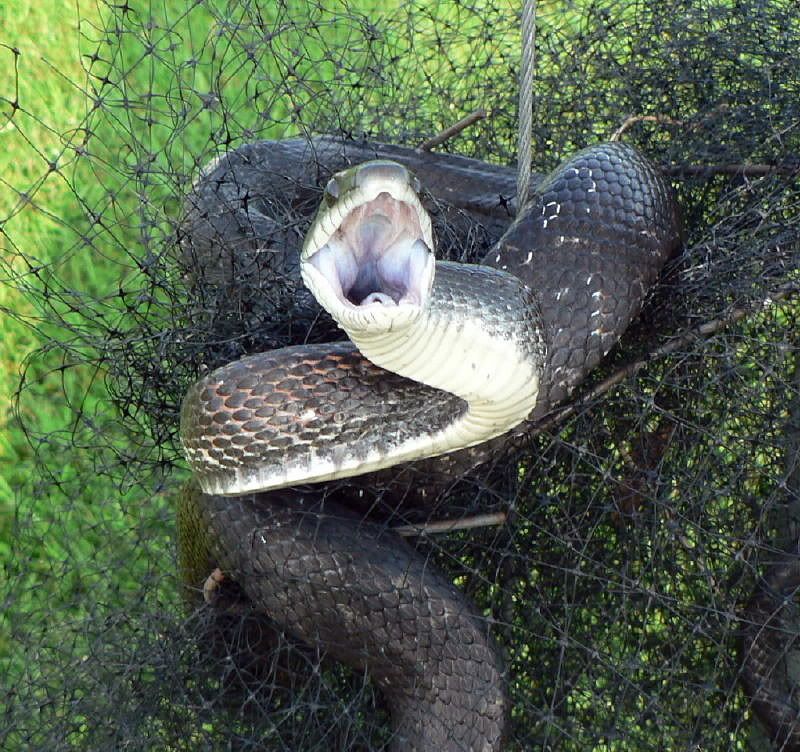
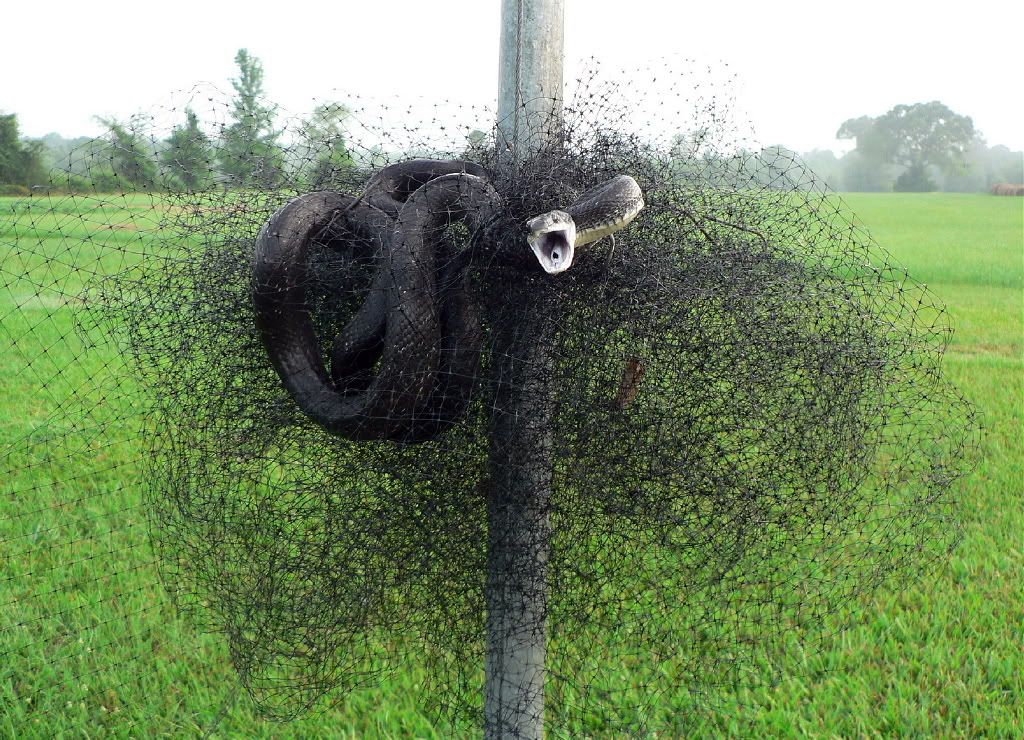
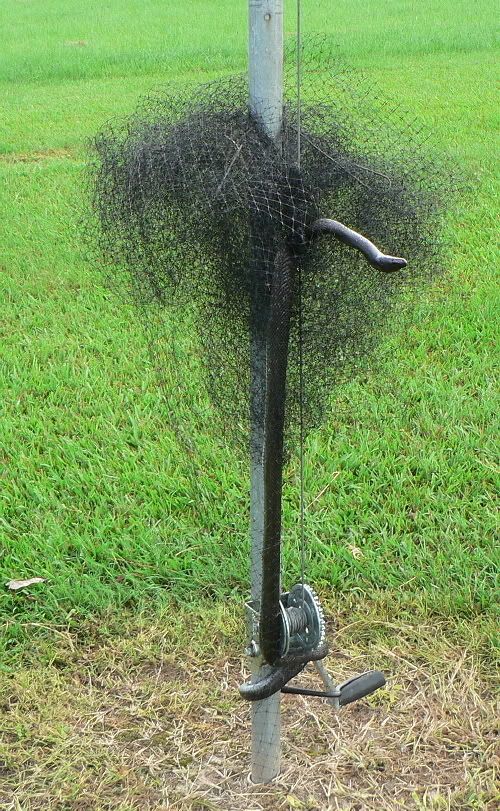

Here are some photos of a large black rat snake that was caught in one of our net traps several years ago. The ¾ inch mesh got the snake. We cut him out of the netting and took several miles away from our colonies and released him in a wooded area.
Steve
Good photos. The netting certainly seems to work well.
Here's a juvenile black rat snake going straight up the side of a tree. That's how I found him. It was about 14 inches. Certainly big enough to take hatchling PMs and small enough to get through a 1/4 inch slit.

Here's a juvenile black rat snake going straight up the side of a tree. That's how I found him. It was about 14 inches. Certainly big enough to take hatchling PMs and small enough to get through a 1/4 inch slit.